

Your St. Augustine turned yellow in July. Your Bermuda didn’t bounce back after winter like the neighbor’s lawn did. You bought a big-box fertilizer labeled “for southern lawns,” applied it exactly as directed, and still saw brown patches by August.
The problem isn’t you. It’s the fertilizer formula. Most products on store shelves are designed for neutral-pH soils and cool-season grasses like Kentucky bluegrass or tall fescue in northern states. North Texas has alkaline clay soil with pH levels between 7.8 and 8.2, plus summer temperatures that hit 100°F regularly from June through August. Those conditions change what works.
Brian at North Texas Lawn Solutions has seen the same pattern for years: homeowners apply the wrong NPK ratio for their grass type, or use quick-release nitrogen during peak heat, and end up burning their lawn instead of feeding it. This guide explains what fertilizer characteristics actually work in North Texas, how to match NPK ratios to Bermudagrass, St. Augustinegrass, and Zoysiagrass, and when to apply for real results.
If you only fertilize once per year, do it in fall (September through early October). Fall feeding helps grass recover from summer stress, builds carbohydrate reserves in roots, and fuels faster spring green-up the following year. Use a low-nitrogen, high-potassium formula like 10-0-20 to strengthen roots without forcing excessive top growth before dormancy.
Texas lawns grow warm-season grasses like Bermudagrass, St. Augustinegrass, and Zoysiagrass. These grasses thrive in heat between 80°F and 95°F, then go dormant when soil temperatures drop below 55°F in winter. Their fertilizer needs are completely different from cool-season grasses like tall fescue or Kentucky bluegrass that dominate northern states.
North Texas adds another layer of complexity: alkaline clay soil. Most soils in Little Elm, Frisco, Oak Point, and surrounding areas measure pH 7.8 to 8.2. At that pH level, iron and other micronutrients get locked up in the soil through a process called iron chlorosis and become unavailable to grass roots. This is why St. Augustine lawns in North Texas turn yellow even when fertilized regularly. The grass isn’t absorbing iron from the soil, and a standard nitrogen-only fertilizer won’t fix it.
High summer temperatures create a third challenge. When soil temperatures exceed 85°F (typically June through August in North Texas), quick-release fertilizers burn grass 40 to 60 percent more often than they would in cooler climates. A formula that works in Michigan or Oregon can scorch a Texas lawn in July because heat accelerates nitrogen release faster than grass can absorb it.
Finally, warm-season grasses enter winter dormancy when soil temperatures drop below 55°F, typically by late November. Fertilizing dormant grass from December through March wastes money and pollutes waterways because dormant grass can’t absorb nutrients. Timing matters more in North Texas than it does in southern cities like Houston or San Antonio where grass stays semi-active year-round.
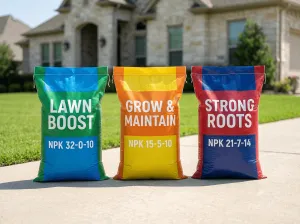
Every fertilizer bag shows three numbers separated by hyphens: 15-5-10, 21-7-14, or 32-0-10. These numbers represent the NPK ratio, which tells you the percentage of nitrogen (N), phosphorus (P), and potassium (K) in the product.
Nitrogen produces green color and dense growth. Warm-season grasses use nitrogen more than any other nutrient, especially during active growing months from April through September.
Phosphorus supports root development in newly seeded or sodded lawns, but Texas clay soil already contains adequate phosphorus levels. Adding more phosphorus doesn’t help your lawn and can cause runoff pollution that harms local waterways by promoting algae growth in lakes and streams.
Potassium strengthens roots, improves drought tolerance, and helps grass handle temperature stress. Texas lawns need potassium to survive summer heat between 95°F and 105°F and recover from winter dormancy.
Texas A&M AgriLife Extension recommends a 3-1-2 or 4-1-2 ratio for established Texas lawns. This means nitrogen should be roughly three to four times the phosphorus amount, and potassium should be about twice the phosphorus amount. The ratio between these three nutrients matters more than the exact percentages.
Here’s how to identify qualifying products:
| Fertilizer Formula | N (Nitrogen) | P (Phosphorus) | K (Potassium) | Ratio Meets 3-1-2? |
|---|---|---|---|---|
| 15-5-10 | 15% | 5% | 10% | Yes (3-1-2) |
| 21-7-14 | 21% | 7% | 14% | Yes (3-1-2) |
| 32-0-10 | 32% | 0% | 10% | Yes (phosphorus-free) |
| 18-6-12 | 18% | 6% | 12% | Yes (3-1-2) |
A 15-5-10 formula means 15 percent nitrogen, 5 percent phosphorus, and 10 percent potassium by weight. Divide 15 by 5 to get 3, and divide 10 by 5 to get 2. That’s a 3-1-2 ratio.
Some formulas like 32-0-10 contain zero phosphorus, which is ideal for established Texas lawns where soil already has sufficient phosphorus. New lawns need some phosphorus for root establishment during the first growing season, but mature lawns established for more than one year don’t benefit from added phosphorus.
St. Augustine requires moderate fertilization compared to other Texas grasses. Apply 2 to 3 pounds of nitrogen per 1,000 square feet annually, spread across 3 or 4 applications: spring (late April when soil reaches 65°F), early summer (May/June), summer (Optional July: application may be skipped during extended periods of extreme heat above 98°F or drought conditions), and early fall (late August/September).
Look for formulas in the 8-2-12 or 15-5-10 range, and make sure they include at least 2 percent iron by weight. Iron is critical for St. Augustine in North Texas. The alkaline clay soil locks up iron through iron chlorosis, causing yellowing leaves with green veins (called interveinal chlorosis). No amount of nitrogen will fix yellow St. Augustine if the problem is iron deficiency caused by high soil pH.
Use slow-release nitrogen formulas to avoid burn during summer months. St. Augustine is more sensitive to fertilizer burn than Bermudagrass, especially during drought stress when grass is already weakened.
Application timing for St. Augustine: spring feeding when soil hits 65°F wakes the grass up from dormancy and sets the foundation for spring growth. Early summer feeding in May/June keeps grass thick through early summer heat. Early fall feeding in late August/September helps recovery from heat stress and prepares roots for winter dormancy.
Bermudagrass is the hungriest grass in North Texas. It needs 4 to 6 pounds of nitrogen per 1,000 square feet annually, which translates to 4 applications during the growing season from April through September.
Use a 15-5-10 formula for spring green-up in April, then switch to higher-nitrogen formulas like 28-0-10 for summer and 10-0-20 for fall applications between May and September. Bermudagrass can handle higher nitrogen levels than St. Augustine, but you still need slow-release formulations in June, July, and August to prevent burn when soil temperatures exceed 85°F.
Space applications every 45 to 60 days from mid-April through September. Stop fertilizing Bermudagrass 6-8 weeks before the first frost (typically mid to late November in North Texas). Fertilizing too late delays dormancy and makes Bermuda more vulnerable to winter damage from freeze-thaw cycles.
Bermudagrass thrives on frequent, moderate feedings rather than infrequent heavy applications. Think of it as feeding a high-performance athlete: consistent nutrition at 1 pound of nitrogen per application produces better results than binge-feeding with 3 pounds at once.
Zoysiagrass is the low-maintenance option. It needs only 1 to 3 pounds of nitrogen per 1,000 square feet annually, applied in 4 treatments spaced 6 weeks apart from April through September.
Use lower-nitrogen formulas that still maintain the 3-1-2 ratio. A 15-5-10 formula works, but apply it at half the rate you’d use on Bermudagrass. Over-fertilizing Zoysiagrass causes thatch buildup, which creates a spongy surface and encourages brown patch fungus and other diseases.
Slow-release nitrogen is especially important for Zoysiagrass. This grass grows slowly by nature, and quick-release nitrogen produces excessive top growth that you’ll have to mow more often while increasing thatch problems.
If your Zoysiagrass looks thin or pale, the issue usually isn’t lack of nitrogen. Check for soil compaction using a soil probe, shade problems from trees blocking more than 4 hours of direct sunlight, or pH problems outside the 5.8 to 7.0 range before adding more fertilizer.
Iron deficiency (iron chlorosis): Leaves turn yellow with green veins still visible. This is called interveinal chlorosis and happens when alkaline soil (pH 7.8+) locks up iron.
Nitrogen deficiency: Entire leaf turns pale yellow or light green uniformly, including veins. Grass grows slowly and looks thin.
In North Texas, St. Augustine yellowing is usually iron deficiency caused by our alkaline clay soil. Adding nitrogen won't fix it. You need a fertilizer with at least 2 percent iron by weight.
All fertilizer rates use "per 1,000 square feet" as the measurement standard. To find your lawn's square footage:
The numbers on the fertilizer bag tell you what nutrients you’re getting. The type of nitrogen determines how fast those nutrients become available to grass roots.
Quick-release nitrogen (water-soluble nitrogen) greens your lawn in 3 to 7 days and lasts 2 to 4 weeks. It works great for early spring green-up in mid-April when you want fast results after winter dormancy. The downside: it burns grass easily in hot weather when soil temperatures exceed 85°F, and you have to apply it more often because nitrogen washes away after heavy rain.
Slow-release nitrogen uses polymer-coated urea (PCU), sulfur-coated urea (SCU), or methylene urea to release nutrients gradually over 6-12 weeks depending on coating thickness. Your lawn gets steady feeding without the burn risk during summer heat. This is the safer choice for summer applications in North Texas from June through August.
Controlled-release coatings regulate nutrient availability based on soil temperature and moisture. Polymer-coated urea slows nitrogen release compared with conventional urea, but release still accelerates when soil is hot and moist, which is when burn risk is greatest. When conditions are ideal for growth in spring and fall, release speeds up naturally.
When to use quick-release nitrogen: Early spring (mid-April) for fast green-up after dormancy, or spot treatment on problem areas that need a quick response before an event.
When to use slow-release nitrogen: All summer applications from June through August when soil temperatures exceed 85°F, fall preparation feedings in September, and any time you want low-maintenance results. New homeowners who don’t want to fertilize every 4 to 6 weeks should use slow-release formulas exclusively.
In North Texas heat, slow-release formulations aren’t just convenient. They’re safer. The 40 to 60 percent higher burn risk with quick-release nitrogen during peak summer temperatures makes slow-release the default choice for most situations between June and August.
When soil temperatures exceed 85°F (June through August in North Texas), quick-release fertilizers burn grass 40 to 60 percent more often than slow-release formulas. Always use slow-release nitrogen from June through August, and apply in early morning or evening when temperatures are cooler. If your grass shows signs of drought stress (blue-gray color or wilting), water for 3 to 4 days before fertilizing.
Wait until soil temperatures hit 65°F before applying your first feeding. If a soil probe isn’t available to measure soil temperature, wait until the lawn has produced enough new growth to require mowing two to three times. In North Texas, this typically happens in mid-April, about 6 weeks after the last spring frost. Applying fertilizer too early can be inefficient because dormant warm-season grasses are unable to use the nitrogen, increasing the risk of nutrient loss from rainfall and raising the potential for disease as temperatures warm.
Use a 15-5-10 or similar 3-1-2 ratio for spring green-up. This first feeding sets the foundation for the growing season by providing nitrogen for green growth and potassium for root development. If your grass greens up slowly compared to neighboring lawns, the issue might be that you’re applying too early (before soil reaches 65°F), not applying too little fertilizer. They may also have a different type of warm season grass.
Bermudagrass needs additional applications every 45 to 60 days during this period to maintain color and density. St. Augustine and Zoysiagrass can often skip the mid-summer feeding unless they show signs of nutrient deficiency like pale color or slow growth.
Critical rule: Use slow-release nitrogen only from June through August. Apply no more than 1 pound of nitrogen per 1,000 square feet per application. Water the lawn 1 to 2 days before application to reduce stress, then water again immediately after to dissolve granules and reduce burn risk.
Apply during the cooler parts of the day like early morning (before 9 AM) or evening (after 6 PM) when soil temperatures are lower. Never fertilize drought-stressed grass that shows signs of wilting or blue-gray color. Water thoroughly for 3 to 4 days first, then fertilize.
Fall fertilization is the most important feeding of the year. It helps grass recover from summer stress, increases turf density, and builds carbohydrate reserves in roots that fuel spring green-up the following year.
Apply between August and September (Early October if you forgot) using a low nitrogen and high-potassium formula like 10-0-20. The low or zero phosphorus content is ideal for established lawns that don’t need root development, and the high potassium improves cold tolerance by strengthening cell walls.
Many homeowners ask: “Is October too late to fertilize?” No. The best fall window in North Texas extends through early October as long as grass is still actively growing. As long as grass blades are still green (not fully dormant and brown), roots will absorb and store the nutrients even if top growth has slowed.
Do not fertilize dormant grass. Warm-season grasses can’t absorb nutrients when dormant because metabolic activity stops when soil temperatures drop below 55°F. Winter applications are inefficient, as dormant turf cannot utilize nutrients. This not only wastes money but can also contribute to nutrient runoff into local waterways and increase disease risk the following spring.
Over-application in summer heat: Applying more than 1 pound of nitrogen per 1,000 square feet between June and August increases burn risk by 40 to 60 percent when soil temperatures exceed 85°F. Use slow-release formulas and apply during cooler morning or evening hours before 9 AM or after 6 PM.
Fertilizing dormant grass: Winter applications from December through February can’t be absorbed by dormant warm-season grasses because metabolic activity stops when soil temperatures drop below 55°F. The nutrients wash away into storm drains through runoff, increase the risk of disease and wastes money. Wait until soil temperatures reach 65°F, typically mid-April.
Using high-phosphorus formulas: Texas clay soil already has adequate phosphorus levels for established lawns. Formulas like 20-20-20 or 10-10-10 add unnecessary phosphorus that builds up in soil and leaches into waterways, promoting harmful algae growth. Choose 32-0-10 (phosphorus-free) or low-phosphorus 3-1-2 ratios instead.
Skipping soil testing: If your lawn isn’t responding to fertilizer despite regular applications, the pH might be outside the ideal range. North Texas soils commonly measure pH 7.8 to 8.2, but the best pH for Texas grasses is 5.8 to 7.0. Texas A&M AgriLife Extension offers soil testing for $12 and provides fertilizer recommendations based on your specific results.
Applying without watering: Granular fertilizer needs moisture to dissolve and move into the soil where roots can absorb it. Water your lawn 1 to 2 days before application to reduce stress, then water again after applying to dissolve granules and prevent burn. Apply at least 0.25 - 0.5 inch of water immediately after spreading fertilizer.
Ignoring iron deficiency: If your St. Augustine is yellow despite regular fertilization, adding more nitrogen won’t fix it because the problem is iron chlorosis caused by alkaline soil pH. You need iron supplementation. Look for formulas with at least 2 percent iron by weight, or apply a separate iron supplement like ferrous sulfate (2 to 4 ounces per 1,000 square feet) in spring and fall.

Calculating lawn square footage, calibrating spreaders, timing seasonal applications, and identifying grass-specific needs takes knowledge most homeowners don’t have time to develop. You can apply fertilizer yourself and get decent results, but professional programs deliver consistent outcomes because the guesswork is removed.
At North Texas Lawn Solutions, Brian creates fertilization & weed control programs specific to your grass type and North Texas soil conditions. The 7-treatment annual program includes pre-emergent weed control applications, seasonal fertilization timed to soil temperatures, and micronutrient applications including iron for St. Augustine. Treatments are spaced every 4 to 6 weeks throughout the growing season, so your lawn never misses the ideal timing window.
Professional programs use soil-matched formulas that account for alkaline clay pH levels between 7.8 and 8.2 and temperature extremes from 100°F in summer to below-freezing in winter. Bermudagrass and St. Augustine get different formulas matched to their specific nitrogen and iron needs. Pre-emergent applications stop weeds like crabgrass and poa annua (bluegrass) before they sprout, so your fertilizer feeds grass instead of competing weeds.
Serving Little Elm, Frisco, Oak Point, Cross Roads, and Lakewood Village. Learn more about our fertilization service for Little Elm lawns. Call (214) 995-9369 to talk with Brian about your lawn’s specific needs, or request a free quote based on your lawn’s square footage.
Brian creates fertilization programs specific to your grass type (Bermuda, St. Augustine, or Zoysia) and North Texas soil conditions. The 7-treatment program includes pre-emergent weed control, seasonal fertilization timed to soil temperatures, and iron applications for St. Augustine. Treatments are spaced every 4 to 6 weeks, so your lawn never misses the ideal window.
Serving Little Elm, Frisco, Oak Point, Cross Roads, and Lakewood Village.
Call (214) 995-9369 or request a free quote based on your lawn's square footage.
The best fertilizer for Texas lawns uses a 3-1-2 or 4-1-2 NPK ratio like 15-5-10 or 21-7-14 with slow-release nitrogen. Bermudagrass needs 4 to 5 applications annually with higher nitrogen levels. St. Augustine needs 2 to 3 applications with added iron to prevent yellowing caused by alkaline soil. Zoysiagrass needs only 1 to 3 applications to prevent thatch buildup.
Apply your first spring feeding when soil temperatures reach 65°F, typically mid-April in North Texas. Fall feeding (September through early October) is the most important application for recovery and spring preparation. Avoid fertilizing dormant grass from December through February because warm-season grasses can’t absorb nutrients when soil temperatures drop below 55°F.
No. In North Texas, the best fall fertilization window extends through early October as long as grass is still actively growing. As long as grass is still green and not fully dormant, roots will absorb nutrients. Use a low-nitrogen, high-potassium formula like 10-0-20 or 5-0-15 for fall applications.
Nitrogen produces green color and dense growth. Potassium increases turf density and drought tolerance. Look for formulas with a 3-1-2 ratio like 15-5-10 (high nitrogen at 15 percent, low phosphorus at 5 percent, moderate potassium at 10 percent). For St. Augustine in alkaline soil, add iron at 2 percent by weight to prevent yellowing that nitrogen alone won’t fix.
Use a low-nitrogen formula like 10-0-20 or 5-0-15 for September applications in Texas. The low or zero phosphorus content is ideal for established lawns because Texas clay soil already has adequate phosphorus, and the high potassium (15 to 20 percent) helps grass recover from summer stress while preparing for winter dormancy. This is the most important feeding of the year for building carbohydrate reserves.