
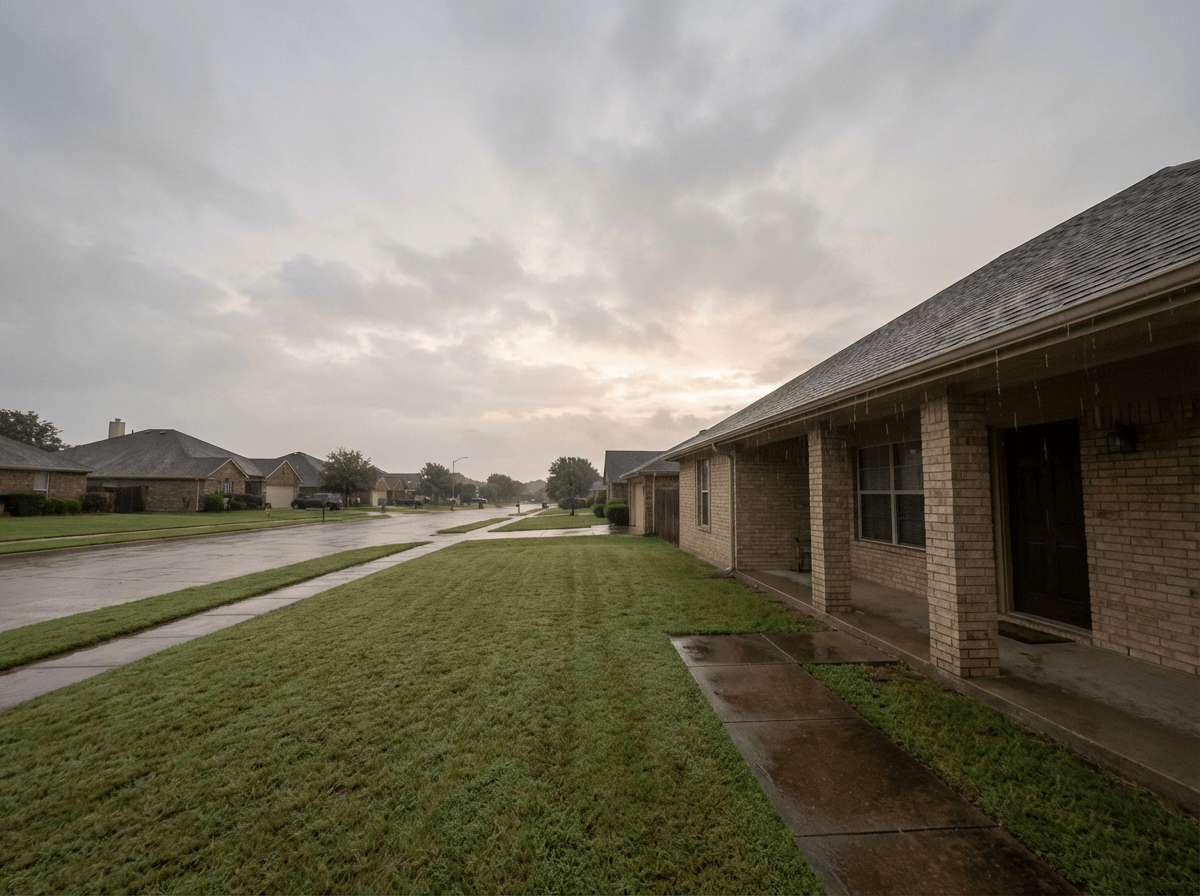
Rain is in tomorrow’s forecast. You have fertilizer ready to spread. Apply now and let nature do the watering, or wait until after the storm passes?
The answer depends on three factors: fertilizer type (granular or liquid), rainfall intensity (light shower or heavy downpour), and grass condition (wet or dry). Light rain totaling 0.25 inch or less activates granular fertilizer perfectly. Heavy rain exceeding 1 inch washes fertilizer into storm drains before your Bermudagrass or St. Augustine can absorb it.
This article explains exactly when to fertilize based on your weather forecast, fertilizer type, and North Texas climate patterns. You’ll learn the specific measurements that separate beneficial rain from damaging runoff, plus how to recognize when your timing went wrong.
Apply granular fertilizer 2-12 hours before light rain (0.25 inch or less), or wait until grass dries after rain stops (usually 2-6 hours). Skip fertilizing if heavy rain (1+ inch) or thunderstorms appear in the forecast.
Apply granular fertilizer 2-12 hours before light rain (0.25 inch or less). This timing allows granules to settle onto soil before activation, saving you from manual watering. Light rain activates granular fertilizer by dissolving pellets and moving nutrients into the root zone where grass absorbs them.
You can also fertilize after rain once grass blades dry (usually 2-6 hours post-storm). The soil stays moist underneath, which creates perfect absorption conditions without runoff risk.
Avoid fertilizing before heavy rain (1+ inch) or thunderstorms. Heavy rainfall washes nutrients away before soil absorption occurs, wasting your investment and polluting local waterways.
Never apply fertilizer to wet grass, regardless of rain timing. Granules stick to wet blades instead of reaching soil, creating uneven distribution, clumping, and increased burn risk.
Here’s what these rainfall amounts mean in real terms:
| Rainfall Amount | Visual Description | Duration | Effect on Pavement |
|---|---|---|---|
| Light rain (0.25 inch or less) | Gentle shower | 1-2 hours | Barely wets pavement |
| Heavy rain (1+ inch) | Typical North Texas thunderstorm | 30-45 minutes | Water running down driveways and streets |
Granular fertilizer doesn’t work until water activates it. The pellets contain concentrated nutrients locked inside a solid form. Without water, they sit on your soil surface doing nothing.
Granular fertilizer requires 0.25-0.5 inches of water to activate and reach the root zone where Bermudagrass and St. Augustine absorb nutrients. Water dissolves the granules, releases nutrients, and carries them through the thatch layer into the root zone. Bermudagrass and St. Augustine absorb nutrients through their roots in this zone, not from surface contact.
Without proper activation, granules stay inert. Your lawn shows no color improvement, no growth response, and no weed suppression. You spent money on fertilizer that never fed your grass.
With proper activation, water dissolves granules gradually over several hours. Nutrients move through thatch (the layer of dead grass between green blades and soil), reach root tips, and get absorbed into grass plants. You see greening within 7-10 days.
North Texas clay soil adds a complication. DFW area clay absorbs water slowly compared to sandy or loamy soil. Clay needs gentle soaking, not flash flooding. A slow 0.25-inch shower over two hours activates fertilizer perfectly. A 2-inch downpour in 30 minutes runs off before clay can absorb it, taking your fertilizer with it.
Granules stick to wet blades instead of reaching soil. You'll get uneven distribution, fertilizer clumping, and brown burn streaks within 24-48 hours. Walk across your lawn first. If your shoes stay dry, grass is ready for treatment.
Light rain totals 0.25 inch or less spread over 1-2 hours. This amount barely wets pavement but soaks into lawn soil effectively. Light rain provides the perfect activation amount because it dissolves granules slowly, gives clay soil time to absorb water, and creates no runoff.
Heavy rain totals 1+ inch falling in a short period. Typical North Texas thunderstorms deliver 1-2 inches in 30-45 minutes. This volume arrives faster than clay soil can absorb it.
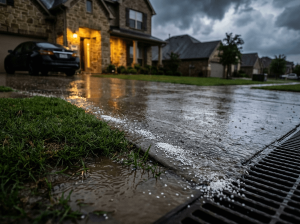
Heavy rain exceeding 1 inch causes nutrient runoff where fertilizer washes into storm drains before soil absorption occurs. Nutrients flow into flower beds, across sidewalks, down driveways, and into storm drains. Your fertilizer feeds algae in Lewisville Lake instead of feeding your Bermudagrass.
Visual cues tell you when rain is too heavy:
| Visual Indicator | What It Means |
|---|---|
| Water running down your driveway or street | Too heavy |
| Puddles forming on lawn surface | Too heavy |
| Dry spots under trees or overhangs staying dry | Likely light enough |
Moderate rain (0.5-1 inch) creates a gray area. Whether this amount helps or hurts depends on how fast it falls and whether your soil was already saturated. If 0.75 inches falls over three hours, that’s likely fine. If 0.75 inches falls in 20 minutes, that’s probably too fast.
The ideal scenario involves applying granular fertilizer 2-12 hours before forecasted light rain. Check your weather app for predicted rainfall amounts, not just “chance of rain.” You need the actual measurement.
Benefits of pre-rain application include saving time and money. Rain activates fertilizer naturally without manual watering. You don’t spend 45 minutes moving sprinklers around your yard. Your water bill stays lower. Nature does the work.
Timing the window correctly matters. Apply too early (24+ hours before rain), and fertilizer sits dry in 90°F heat. Nitrogen can volatilize (evaporate) before rain arrives. Apply too late (during actual rainfall), and you’re working in the rain while granules wash away immediately.
Granular fertilizer handles this timing well because most formulas use slow-release technology. Even if rain arrives slightly heavier than predicted, slow-release pellets don’t dissolve instantly. Some nutrients get absorbed, even if efficiency drops.
Always apply to dry grass, even before rain. Wet blades cause granules to stick rather than fall to soil level. Walk across your lawn first. If your shoes don’t get wet from grass contact, blades are dry enough.
Summer heat adds urgency. Above 85°F, nitrogen volatilizes faster. Brian doesn’t apply granular fertilizer more than 12 hours before predicted rain during June, July, and August. Heat accelerates volatilization, so activation needs to happen sooner.
What to avoid:
| Scenario | Why to Avoid |
|---|---|
| Applying before predicted thunderstorms | Too much rain too fast |
| Applying before flash flood warnings | Extreme runoff risk |
| Applying before multi-day heavy rain events | Soil saturation prevents absorption |
Applying granular fertilizer 2-12 hours before light rain allows the product to settle on soil before activation, getting nutrients to roots efficiently.
Brian checks 48-hour forecasts before every treatment in our 7-treatment fertilization & weed control program. If heavy rain appears likely, we reschedule to protect your investment and prevent environmental damage.
Post-rain fertilization provides the safest timing approach. Apply after rain stops and grass blades dry, which usually takes 2-6 hours depending on sun and wind conditions.
Benefits include eliminated guesswork. You know exactly how much rain fell. You can see whether your soil absorbed water or if puddles indicate saturation. You make decisions based on actual conditions, not weather forecasts.
Soil moisture stays ideal after rain. The top 1-2 inches of soil remain damp, which helps nutrients move into the root zone quickly once you apply fertilizer. You get fast activation without runoff risk.
Check grass dryness before applying. Walk across your lawn. If shoes don’t get wet from grass blade contact, you’re ready to fertilize. Grass dries faster than soil, especially on sunny, breezy days.
Check soil moisture too. Stick your finger 1-2 inches into soil. Soil should feel damp but not muddy. If water squeezes out when you press soil, wait another day for drainage.
Liquid fertilizer works especially well after rain. Liquid fertilizer requires 4-6 hours without rainfall for complete absorption through grass blades, while granular fertilizer benefits from immediate light rain activation. Apply liquid formulas to moist soil for fast absorption through both grass blades and soil. Liquid products get absorbed in hours rather than days.
When NOT to apply after rain:
| Condition | Why to Wait |
|---|---|
| Ground is muddy or saturated | Wait for drainage |
| Puddles remain on lawn surface | Soil can’t absorb more water |
| Forecast shows more heavy rain within 4-6 hours | Runoff, defeats the purpose |
Equipment works better on dry grass too. Fertilizer spreaders don’t distribute evenly when wet grass clumps in the hopper. Application quality improves when blades are dry.
Post-rain fertilization to dry grass and moist soil provides ideal nutrient absorption conditions while eliminating runoff risk.
Liquid and granular fertilizers behave differently around rain. Understanding these differences helps you time applications correctly.
Liquid fertilizer gets absorbed in 4-6 hours through grass blades and soil. Granular fertilizer takes days to fully activate as water slowly dissolves pellets and releases nutrients.
Granular before light rain: This combination works perfectly. Rain does your watering-in automatically. Nutrients get activated and moved into the root zone without manual effort.
Granular after rain: This approach also succeeds. Apply once grass dries. Moist soil underneath helps nutrient movement. You control timing based on actual rainfall received.
Liquid after rain: This timing provides the best approach for liquid products. Moist soil accepts liquid fertilizer quickly. Grass blades absorb foliar nutrients fast. You see greening responses within 3-5 days.
Liquid before rain: This scenario creates risk. Liquid fertilizer needs 4-6 hours without rainfall for complete absorption. If rain arrives sooner, water-soluble nutrients wash away before absorption occurs. You lose most of the application.
Product type matters for North Texas weather variability. Summer thunderstorms pop up unpredictably. Morning forecasts often change by afternoon. Brian uses slow-release granular fertilizer in our fertilization treatments because granular formulas handle weather uncertainty better than liquid products.
Applying fertilizer to wet grass creates multiple problems that reduce effectiveness and damage your lawn.
Problem 1: Granules stick to wet blades. Instead of falling to soil level where roots access nutrients, pellets adhere to wet grass. Nutrients get trapped above the root zone.
Problem 2: Uneven distribution. Fertilizer clumps together on wet turf. Some areas receive double or triple the intended amount. Other areas get nothing. You see patchy results.
Problem 3: Increased burn risk. Concentrated fertilizer in direct contact with wet grass blades causes leaf damage. Nitrogen burns manifest as yellow or brown streaks across your lawn within 24-48 hours.
Problem 4: Equipment malfunction. Broadcast spreaders don’t distribute evenly when wet grass clumps in the hopper. Rotary mechanisms get jammed. Application quality suffers.
Problem 5: Soil compaction. Walking on wet lawn compacts clay soil. Compacted soil restricts root growth and water infiltration. Your lawn struggles even after fertilizer activates.
Visual results show the mistake quickly:
| Symptom | Cause |
|---|---|
| Dark green streaks | Fertilizer clumping in concentrated areas |
| Yellow or brown spots | Burn damage from direct blade contact |
| Uneven growth patterns | Inconsistent nutrient distribution |
If you already applied fertilizer to wet grass, fix the problem immediately. Water heavily with another 0.25 inch to wash granules off blades down to soil level. This dilutes concentrated spots and redistributes nutrients more evenly.
Prevention beats correction. Fertilizer applied to wet grass adheres to leaf blades rather than reaching soil, causing uneven nutrient distribution and increased burn risk.
Don’t panic immediately if unexpected rain arrives after application. Check how much rain actually fell and how soon after you fertilized.
If light rain within 24 hours: Your fertilizer probably activated successfully. Light rain helps rather than hurts. Monitor your lawn for greening over the next 7-10 days.
If heavy downpour within 2-4 hours: Significant nutrient loss likely occurred, especially with quick-release formulas. Water moved granules before dissolution and absorption happened.
Visual signs of washout include:
| Sign | What It Indicates |
|---|---|
| Fertilizer granules visible in flower beds, on sidewalks, or in gutters | Physical washout occurred |
| No greening response after 7-10 days | Nutrients washed away before absorption |
| Lawn appearance unchanged from pre-application | Treatment was ineffective |
| Algae growth in nearby storm drains or street gutters | Nutrients entered water system |
How to assess damage: Wait 7-10 days before making decisions. Look for color changes and growth responses. If your Bermudagrass or St. Augustine shows improvement, nutrients absorbed successfully despite the rain. If the lawn looks identical to pre-treatment, fertilizer washed away.
Don’t automatically reapply. Observe lawn response first. Doubling fertilizer applications risks burn damage and environmental pollution. If you see partial greening, partial nutrients absorbed. Adding a full second application delivers excessive nitrogen.
Cost considerations matter too. Treating a 15,000 square foot lawn costs $40-60 in fertilizer materials. Washout represents significant waste. Environmental concerns compound the loss because heavy rainfall within 4 hours of fertilizer application causes nutrient runoff where water-soluble compounds wash into storm drains before grass roots absorb them.
When to call for professional assessment: If you’re unsure about reapplication timing or correct amounts, contact us at (214) 995-9369. Brian evaluates lawn response and recommends appropriate next steps based on grass condition and weather patterns.
North Texas climate creates specific challenges for fertilizer timing. Understanding seasonal patterns helps you schedule applications successfully.
Spring (March-May): Frequent rainfall makes spring ideal for fertilizer activation. Plan applications 1-2 days before predicted showers. Rain arrives reliably enough to trust forecasts. Bermudagrass breaks dormancy and needs nutrients. Light, frequent rain activates fertilizer without runoff risk.
Summer (June-August): Scattered thunderstorms develop unpredictably. Morning forecasts often miss afternoon pop-up storms. Heat accelerates nitrogen volatilization, so fertilizer can’t sit dry for long.
Summer strategy: Apply early morning (6-8am) when grass is dry and temperatures stay below 85°F. Complete application before afternoon storm development. This timing captures morning dew evaporation while avoiding midday heat and evening thunderstorms.
Apply early morning (6-8am) when grass is dry and temperatures stay below 85°F. Complete application before afternoon thunderstorm development. This timing captures morning dew evaporation while avoiding midday heat that accelerates nitrogen volatilization and unpredictable pop-up storms.
Fall (September-November): More stable weather patterns make fall easier for timing around forecasts. St. Augustine and Bermudagrass store nutrients for winter. Rain arrives less frequently, so manual watering becomes more common. Reminder: fertilizing in late October and November is probably too late due to potential frost risk.
Drought considerations: If no rain appears in the 7-day forecast, you must water fertilizer in manually. Apply 0.25-0.5 inch through sprinklers or irrigation within 24 hours of application. Fertilizer sitting dry for multiple days in heat can volatilize nitrogen and lose its effectiveness.
Flash flood risk: DFW area experiences sudden heavy rainfall, especially during spring and early summer. Always check radar apps in addition to forecast predictions. Radar shows actual storm development and movement. Forecasts sometimes underestimate intensity.
Heat and volatilization: Above 85°F, nitrogen in granular fertilizer can volatilize if left unactivated. The hotter the temperature, the faster volatilization occurs. Summer applications need activation within 24 hours maximum. Brian schedules summer treatments based on 48-hour forecasts and current soil moisture conditions. We avoid hot, dry periods with no rain predicted.
North Texas summer thunderstorms delivering 1-2 inches in 30 minutes cause fertilizer washout, requiring morning applications before afternoon storm development.
Bermudagrass dominates North Texas lawns. Bermudagrass is a warm-season grass that grows actively from April through September and requires 4-6 fertilizer applications during the growing season for best health. St. Augustine serves as the shade-tolerant alternative in areas where Bermudagrass struggles. Both grass types need multiple fertilizer applications during the growing season for best health and color.
Fertilizer runoff from poorly timed applications damages local water quality. Understanding this impact motivates better timing decisions.
When heavy rain washes fertilizer off lawns, nutrients flow into storm drains. These drains connect directly to creeks without treatment. Creeks flow to Lewisville Lake, Lake Ray Hubbard, and the Trinity River. Excess nitrogen and phosphorus in these water bodies cause eutrophication.
Fertilizer runoff from heavy post-application rainfall causes eutrophication in local waterways where excess nitrogen triggers algae blooms and oxygen depletion. Massive algae blooms cover water surfaces, block sunlight, and consume oxygen. When algae die and decompose, oxygen levels drop further. Fish and aquatic life suffocate in oxygen-depleted water.
The Gulf of Mexico dead zone illustrates this problem at scale. This 6,000+ square mile area experiences seasonal oxygen depletion severe enough to kill marine life. Fertilizer runoff from lawns, farms, and golf courses throughout the Mississippi River watershed contributes to this environmental disaster.
Storm drains in Little Elm and Frisco connect directly to creeks without treatment. Those creeks flow to Lewisville Lake and Lake Ray Hubbard. Fertilizer washed off during heavy rain causes algae blooms and fish kills. Proper rain timing protects your lawn investment AND local water quality.
Local responsibility starts with proper timing. Applying fertilizer before heavy rain sends nutrients into North Texas lakes and streams. The Trinity River watershed supports recreational fishing, drinking water supplies, and wildlife habitat. Protecting water quality requires preventing runoff through smart timing decisions.
HOA considerations matter in neighborhoods with retention ponds. Some homeowners associations restrict fertilizer applications near water features. Check your HOA guidelines before treating lawns adjacent to ponds or creeks.
Slow-release fertilizer reduces environmental risk. These formulas release nutrients gradually over 6-8 weeks rather than all at once. A single heavy rain event after slow-release application doesn’t wash away the entire treatment because most nutrients remain locked in pellets. Quick-release formulas dissolve faster, making them more vulnerable to washout.
Brian uses slow-release granular products and careful application timing to minimize environmental impact. Protecting local water quality benefits everyone in the community.
Our weed control approach relies on precise timing and targeted spot treatments to keep total chemical use down. Combining fertilization with pre-emergent weed control reduces reliance on post-emergent herbicides.
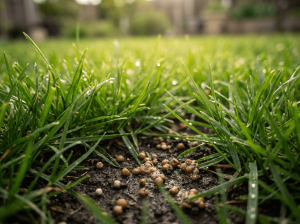
Use this checklist before every fertilizer application to get timing right:
Our fertilization & weed control program includes 7 treatments spaced 4-6 weeks apart throughout the growing season. Brian handles all weather monitoring and timing decisions. If heavy rain threatens a scheduled treatment, we reschedule automatically and notify you.
Let us handle the timing complexity. Call or text (214) 995-9369 for a free quote on professional fertilization service.
Professional fertilization service removes weather timing stress from your schedule. Here’s how Brian manages rain timing for consistent results.
Our process: Check 48-hour weather forecasts before every scheduled treatment. We review predicted rainfall amounts, not just percentages. If forecasts show heavy rain within the treatment window, we contact you to reschedule.
Flexibility built in: Treatments occur 4-6 weeks apart, providing schedule flexibility. Missing a specific day doesn’t create gaps in coverage. We adjust timing within the 4-6 week window based on weather conditions.
Product choice: Slow-release granular formulas provide a buffer against unexpected rain. Even if a pop-up storm arrives sooner than predicted, slow-release nutrients don’t wash away completely. You get partial benefit minimum, full benefit when timing goes well.
Customer communication: Text or call if rescheduling becomes necessary due to weather. You stay informed about application timing changes without managing the forecast monitoring yourself.
7-treatment schedule advantages: Three pre-emergent applications (September/October through February/March) prevent weeds before they germinate. Four fertilization applications (April through August/September) feed active growth. Spacing treatments 4-6 weeks apart allows weather flexibility while maintaining consistent coverage.
Experience advantage: Brian knows North Texas weather patterns from years of treating Little Elm and Frisco lawns. Summer thunderstorm timing, spring rain frequency, and fall drought periods all factor into scheduling decisions. Local experience beats generic national advice.
Track record: Minimal washout issues because of careful weather monitoring. When rare washout occurs, we assess lawn response and provide reapplication at no additional cost if necessary. Your investment gets protected.
Year-round coverage: Pre-emergent treatments prevent crabgrass, poa annu (bluegrass), and other weeds during their germination windows. Fertilization treatments feed grass during active growth periods. Rain timing matters for both product types, and we handle timing for both.
Get consistent, weather-smart lawn fertilization without forecast monitoring stress. Professional fertilization services monitor 48-hour weather forecasts to schedule applications during ideal rainfall windows, getting nutrients to roots efficiently while preventing waste.
Call or text (214) 995-9369 or request a free quote through our website www.ntxlawnsolutions.com.
Additional lawn treatments benefit from proper rain timing too. Our fire ant control treatments need similar activation, though the 12-month spot-treat guarantee means occasional rain washout gets corrected through follow-up visits at no additional charge.
Brian monitors 48-hour forecasts and adjusts your treatment schedule automatically. Get consistent fertilization results without the timing stress.