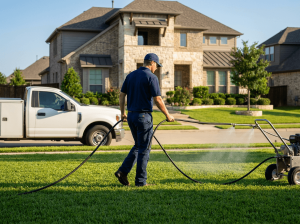
You’re standing in the lawn care aisle staring at 30 different fertilizer bags, trying to decode NPK ratios and application rates. Or maybe you’re looking at a quote from a lawn care company, wondering if it’s worth paying someone else to do something you could handle yourself.
This article compares DIY lawn fertilization to professional service with real cost breakdowns, step-by-step application techniques, and honest assessments of when each approach makes sense. By the end, you’ll know exactly what equipment you need, how to avoid the mistakes that damage lawns, and whether hiring a pro fits your situation.
We’re North Texas Lawn Solutions, fertilization and weed control specialists serving Little Elm, Frisco, Oak Point, and surrounding areas. Brian has helped hundreds of homeowners get healthy lawns without the guesswork, but we also respect that DIY can work when you have the right knowledge and time.
Fertilizer delivers three essential nutrients to your lawn through nitrogen-phosphorus-potassium (NPK) ratios. Nitrogen promotes chlorophyll production in grass blades, which creates the green color and drives vertical growth. Phosphorus supports root cell division below the soil surface, which increases drought tolerance. Potassium strengthens cell walls in grass tissue, which improves disease resistance and heat stress recovery.
Warm-season grasses in North Texas (Bermuda grass, St. Augustine grass, and Zoysia grass) require feeding every 4-6 weeks during active growth from April through September. This timing matches soil temperature cycles specific to the Dallas-Fort Worth region.
The numbers on fertilizer bags show the NPK ratio, which represents the percentage by weight of nitrogen, phosphorus, and potassium. A 32-0-10 fertilizer contains 32% nitrogen, 0% phosphorus, and 10% potassium. The remaining 58% is carrier material (typically sand or inert granules) that helps distribute the nutrients evenly across your lawn.
Lawns need regular fertilization because nutrients get depleted through multiple pathways. Mowing removes nitrogen-rich grass clippings from the lawn ecosystem. Rainfall and irrigation leach nutrients below the 6-inch root zone where grass cannot access them. Microbial decomposition in North Texas clay soil consumes available nitrogen, reducing plant-available nutrients by 30-40% between applications.
In the Dallas-Fort Worth area, soil temperatures reach the critical 65°F threshold by mid-April. Brian recommends waiting until after 2-3 mows, usually around mid-April in our area, before applying the first spring fertilizer. Applying fertilizer when soil temperatures remain below 65°F wastes nutrients because warm-season grass roots cannot absorb nitrogen until metabolic activity increases with warming soil.
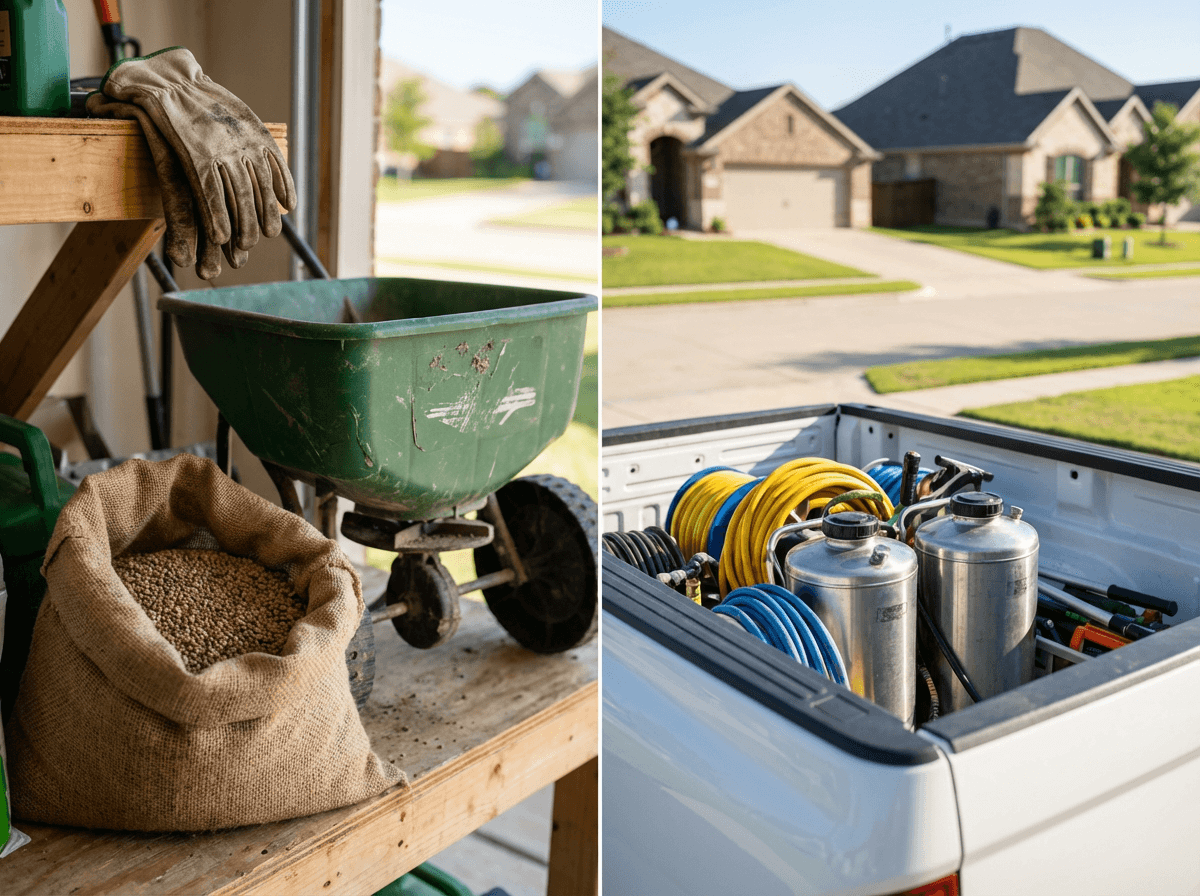
DIY lawn fertilization requires a broadcast spreader ($50-$300) and granular fertilizer products ($80-$200 annually for 4-5 applications). First-year investment typically exceeds $300 when following a proper program with quality equipment and sufficient product for multiple applications.
| Equipment Item | Cost Range | Application Notes |
|---|---|---|
| Handheld spreader | $11-$30 | Lawns under 2,000 sq ft only |
| Push broadcast spreader | $50-$300 | Standard for lawns 2,000-10,000 sq ft |
| Fertilizer (annual supply) | $80-$200 | 4-5 applications for 5,000 sq ft lawn |
| Soil test kit | $10-$30 | Every 3-5 years recommended |
| First Year Total | $150-$530+ | Excludes time or correction of application errors |
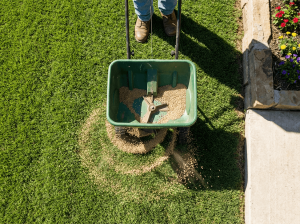
Broadcast spreaders distribute fertilizer granules in a 7-11 ft arc pattern using a rotating disc mechanism powered by wheel rotation. They cover large areas quickly but require steady 3 mph walking pace to maintain even coverage. Drop spreaders provide more precise application with fertilizer falling straight down through adjustable gate openings, but they’re slower and better suited for lawns under 5,000 sq ft or edging applications where precision prevents overspray onto pavement.
Storage becomes a practical constraint. You need dry, climate-controlled space for the spreader plus 40-50 pound bags of fertilizer. Granular products exposed to moisture clump together, which causes uneven flow through spreader mechanisms and creates application inconsistency. Most homeowners dedicate 10-15 square feet of garage or shed space to lawn care equipment and product storage.
Time investment for DIY fertilization includes research before your first application (2-4 hours), lawn area measurement and calculation (30-45 minutes initial), spreader calibration per product (15-20 minutes), actual application time (45-60 minutes for 5,000 sq ft), and post-application monitoring for burn symptoms (weekly checks for 2 weeks). Expect 60-90 minutes per application once you develop consistent technique.
Not sure about your grass type or when to start feeding? Our fertilization & weed control program removes the guesswork with timing specific to your lawn and North Texas climate.
Apply granular fertilizer to completely dry grass blades, starting with the lawn perimeter positioned three feet from property edges. Walk at a steady 3 mph pace (normal walking speed) while filling the interior with parallel side-by-side rows. Overlapping will happen but try to avoid overlapping more than 6-12 inches. Water the treated lawn to 0.25-0.5 inch depth within 24 hours to dissolve granules and move nutrients into the soil.
Here’s the complete application process:
1. Measure your lawn area accurately. Calculate square footage by measuring length times width for each lawn section. Deduct non-turf areas like driveways, patios, sidewalks, and flower beds from total calculations. Most homeowners overestimate lawn size by 20-30% when they skip detailed measurement, which leads to running out of product mid-application.
2. Read product label specifications exactly. Follow manufacturer rate recommendations without modification for first applications. Adjust spreader dial settings based on the calibration chart provided with your specific fertilizer brand. Each fertilizer formulation requires different settings even when using the same spreader model due to granule size variation and density differences.
💡
Before fertilizing your entire lawn, test your spreader settings on a small 100 square foot section. Mark the area with landscaping flags, apply fertilizer, then verify coverage looks even without gaps or overlaps. This 5-minute test prevents expensive mistakes across your entire lawn. Adjust your walking pace or dial settings based on what you observe, then proceed with confidence.
3. Apply only to dry grass blades. Never apply fertilizer when grass blades are wet from recent rain or irrigation. Wet grass surfaces cause fertilizer granules to stick to leaf tissue instead of falling through to the soil surface, which concentrates salt levels on blades and increases burn risk by 300-400%.
4. Start with perimeter application. Apply fertilizer around the lawn edges first, positioning your path three feet from property boundaries, sidewalks, and driveways. This technique establishes a buffer zone and prevents you from making sharp direction changes with a loaded spreader, which dumps concentrated fertilizer during turns.
5. Fill interior with parallel rows. Walk at a steady 3 mph pace equivalent to normal walking speed (test this with a stopwatch over 100 feet). Make parallel passes back and forth across the lawn interior. Maintain 6-12 inch overlap between adjacent passes but avoid excessive overlap exceeding 18 inches, which doubles application rates and creates dark green stripes from nitrogen overload.
6. Water treated areas within 24 hours. Apply 0.25-0.5 inch of water measured with rain gauges or straight-sided containers. This irrigation dissolves granules, moves nutrients into the soil root zone, and prevents salt crystal buildup on the surface that causes osmotic burn damage to grass crowns.
7. Monitor for burn symptoms immediately. Watch for burn indicators like brown patches, yellow streaking, or wilted grass after application. If you observe damage symptoms, flood affected areas immediately with 1-2 inches of water to dilute fertilizer salt concentrations and flush excess nutrients below the root zone.
Spreader calibration controls nutrient application rate accuracy. Most residential spreaders use numbered dial settings from 1-20 or letter-coded settings A-G. Start conservative at settings 25% lower than label recommendations, especially for your first seasonal application. You can always add supplemental fertilizer to correct under-application, but you cannot remove excess fertilizer once granules contact soil moisture.
Walking pace affects application uniformity more than most homeowners realize. Walking slower than 3 mph over-applies fertilizer by extending dwell time over each lawn section. Walking faster than 3 mph creates coverage gaps between spreader passes. Practice maintaining a steady pace before opening the hopper gate.
Fertilizer burn occurs when excess salt concentrations in fertilizer draw moisture from grass roots through osmotic pressure differential. Burn symptoms appear as brown or yellow patches typically within 24 - 72 hours but can appear up to 5 - 7 days after application. The symptoms typically appear in distinct patterns that mirror the spreader’s application paths, highlighting areas of uneven coverage. Recovery requires flooding damaged areas immediately with 1-2 inches of water and waiting 2-4 weeks for new growth to replace damaged tissue.
The most damaging mistake homeowners make is applying fertilizer with the spreader hopper gate wide open without checking dial settings. This error doubles or triples the intended application rate, guaranteeing burn damage across the entire lawn. Brian identifies this problem pattern regularly in Little Elm and Frisco lawns, especially after homeowners attempt their first spring fertilization without spreader calibration.
Common DIY fertilization errors that damage North Texas lawns:
| Error Type | Why It Damages Grass | Prevention Method |
|---|---|---|
| Applying before soil warms to 65°F | Roots cannot absorb nutrients; fertilizer salts accumulate; this could increase risk for disease | Wait until mid-April minimum in DFW area |
| Over-application from incorrect settings | Doubles salt concentration, pulls water from roots | Start 25% below label rate, calibrate carefully |
| Fertilizing during drought or heat stress | Stressed grass cannot metabolize nutrients | Skip applications when temps exceed 95°F for 7+ days |
| Applying to wet grass blades | Granules stick to leaves, concentrate salts on tissue | Apply only when grass is completely dry |
| Skipping spreader calibration | Wrong flow rate wastes product or burns lawn | Calibrate for each fertilizer brand and formulation |
| Excessive overlap (more than 12 inches) | Doubles rate in overlap zones, creates stripes | Mark rows if necessary, maintain consistent spacing |
| Not watering within 24 hours | Dry granules sit on surface, concentrate salts | Apply 0.25-0.5 inch irrigation immediately |
Timing mistakes are particularly common in North Texas lawns. Applying fertilizer too early in spring (before mid-April) wastes money and increases the risk for disease because soil temperatures below 65°F prevent root absorption. Applying too late in fall after October 1st pushes late-season growth that’s vulnerable to early frost damage when overnight temperatures drop below 32°F.
Miscalculating lawn area leads to running out of product halfway through application or buying twice the required amount. Measure lawn sections carefully with a measuring wheel and verify total square footage before purchasing fertilizer quantities.
⚠️
The worst error Brian sees in Little Elm and Frisco lawns: applying fertilizer with the spreader hopper gate wide open without checking dial settings. This doubles or triples the application rate and burns the entire lawn. Always calibrate your spreader before opening the gate. Start 25% below the label recommendation until you gain experience. You can add more fertilizer later, but you cannot remove excess once it hits the soil.
Professional lawn fertilization programs utilize commercial-grade products formulated specifically for warm-season grasses in North Texas, in contrast to standard retail fertilizers marketed for general southern lawns. Licensed applicators provide timing precision based on soil temperature monitoring, custom seasonal formulations adjusted for grass type, and combination treatments (fertilizer plus weed control) not available to homeowners. Programs typically include 7 annual treatments spaced at 4-6 week intervals.
Temperature-responsive polymer coating technology on professional slow-release products controls nutrient release rates based on soil temperature cycles and moisture levels. Summer formulations might use 25% quick-release nitrogen for immediate greening response and 75% polymer-coated slow-release for sustained 6-8 week feeding. This prevents the feast-or-famine growth cycles common with basic retail granular products that release all nutrients within 2-3 weeks.
Professional applicators identify specific grass species and adjust fertilization programs accordingly. Bermuda grass requires higher nitrogen rates (4-6 pounds per 1,000 sq ft annually) and tolerates summer heat applications. St. Augustine grass needs moderate nitrogen (3-4 pounds per 1,000 sq ft) with higher iron supplementation to prevent chlorosis in alkaline North Texas soil. Zoysia grass has unique low-nitrogen requirements (2-3 pounds per 1,000 sq ft) compared to both Bermuda and St. Augustine. Brian identifies your exact grass species and matches fertilization timing plus formulation to its biological requirements.
Combination treatments save application trips and increase treatment effectiveness. North Texas Lawn Solutions combines granular fertilizer with post emergent weed control in single applications during spring & summer (April - September) windows. This approach eliminates crabgrass and other annual weeds while feeding grass, accomplishing two lawn care objectives in one treatment cycle.
Our 7-treatment annual program delivers year-round nutrition and weed prevention:
Higher potassium ratios (0-0-20 or similar) in fall treatments improve cold tolerance and carbohydrate storage in grass crowns. Higher nitrogen formulations (32-0-10 or similar) in late spring drive peak vertical growth when soil temperatures exceed 75°F and grass can metabolize nitrogen efficiently.
Risk mitigation provides significant value. If North Texas Lawn Solutions damages your lawn through application error, we repair the damage at no additional cost. This guarantee covers correction expenses that would cost homeowners $200-500 to repair independently through overseeding, soil amendment, or replacement fertilization.
Commercial broadcast spreaders maintain consistent flow rates across varying terrain compared to consumer models that fluctuate with wheel speed changes.
Regional climate expertise matters substantially. Understanding North Texas soil temperature patterns (65°F threshold timing), rainfall timing (spring and fall peaks), heat stress periods (July-August 95°F+ stretches), and grass dormancy schedules (Bermuda goes dormant at 50°F soil temps) helps Brian time applications for maximum nutrient uptake effectiveness. This knowledge base cannot be replicated from national lawn care brand generic schedules designed for nationwide markets spanning different climate zones.
Looking for consistent results without the research and application work? Get a free quote to see what professional fertilization costs for your specific lawn size.
DIY fertilization costs $80-$200 annually after initial equipment purchase, while professional service is priced by your lawn's square footage. First-year DIY costs run higher than later years because of the spreader purchase ($50-$300) plus learning curve mistakes that require corrective treatments.
| Cost Factor | DIY | Professional |
|---|---|---|
| Equipment (first year) | $100-$300 | $0 |
| Products (annual) | $80-$200 | Included in service package |
| Time investment | 8-12 hours/year | 0 hours client time |
| Mistake risk | High (homeowner absorbs all correction costs) | Covered by service guarantee |
| Knowledge requirement | Extensive research needed across multiple sources | Expert knowledge provided |
| Year 1 Total (5,000 sq ft) | $180-$500+ | Priced by lawn size |
| Year 2+ Total | $80-$200 | Priced by lawn size |
📊
Year one DIY often costs MORE than professional service when you account for equipment purchase ($100-300) plus learning mistakes. One fertilizer burn incident requiring repair costs $200-400 in corrective products and labor.
Year 2 forward: DIY can cost less than professional service when execution is perfect. But "when everything goes right" requires proper timing, correct calibration, accurate measurements, and appropriate products for your grass type.
The cost comparison shows DIY can save money if you avoid application mistakes and value your time at $0 per hour. Year one often costs more when you account for equipment purchase ($100-$300) plus learning mistakes (one fertilizer burn incident requiring repair costs $200-400 or more in corrective products and labor).
Year two forward, DIY can come out cheaper when application execution is perfect. However, “when everything goes right” requires proper seasonal timing, correct spreader calibration, accurate lawn measurements, and appropriate product selection for grass type. Most homeowners make costly mistakes during their first 1-2 fertilization seasons.
Hidden DIY costs include time opportunity value. If you value personal time at $25/hour, the 8-12 hours you spend annually on fertilization research, shopping, application, and monitoring adds $200-300 to real economic cost. Storage space occupies valuable garage area. Learning mistakes carry financial consequences.
Professional service includes commercial-grade products unavailable at retail stores. The cost comparison isn’t equivalent because professional 38-0-6 formulations with polymer coating work more effectively than retail 16-4-8 basic granular fertilizers. You’re paying for superior nutrient delivery technology and expert application timing, not just labor convenience.
Busy homeowners often find the cost difference between DIY and professional service worthwhile to reclaim 8-12 weekend hours annually and eliminate lawn care decision stress.
DIY fertilization works well for lawns under 3,000 sq ft when homeowners have time and genuine interest in lawn care. Professional service makes more sense for lawns exceeding 10,000 sq ft, busy schedules with limited weekend availability, or problem lawns needing expert diagnosis for persistent issues. Consider lawn size, time availability, and problem complexity when deciding between approaches.
DIY fertilization works well when:
Professional service makes sense when:
Hybrid approach option:
Some Little Elm and Frisco homeowners use professional service for spring pre-emergent (February-March) and fall pre-emergent (September-October) when timing precision matters most, then handle summer maintenance applications themselves. This captures expert timing during important weed prevention windows while lowering annual cost.
Other homeowners start with DIY, encounter problems they cannot diagnose (persistent brown patches, weed breakthrough, unexplained thinning), then switch to professional service for diagnosis and correction. This reactive approach often costs more total than starting with professional service because damage repair adds expense beyond standard treatment costs.
There’s no single best answer for all homeowners. The right choice depends on your specific lawn size, available weekend time, genuine interest in lawn care learning, and whether your lawn has existing problems requiring expert attention. A healthy 2,500 sq ft Bermuda grass lawn presents very different considerations compared to a struggling 12,000 sq ft St. Augustine property with persistent crabgrass pressure, chinch bug damage and signs of disease.
If you’re uncertain whether your lawn situation needs expert evaluation, call or text (214) 995-9369 and describe symptoms you’re observing. Brian can often determine over the phone whether the issue is manageable with DIY correction or requires professional diagnosis and treatment.
⭐
Choose DIY when: Your lawn is under 3,000 sq ft, healthy without major issues, and you genuinely enjoy outdoor projects with time for proper application.
Choose professional when: Your lawn exceeds 10,000 sq ft, you value 8-12 hours of weekend time more than the savings, or your lawn shows persistent problems requiring expert diagnosis.
North Texas Lawn Solutions provides professional fertilization and weed control throughout Little Elm, Frisco, Oak Point, Cross Roads, and Lakewood Village. If you live nearby, our pages on weed control in Frisco and lawn fertilization in Little Elm explain how the program works in your area. Unlike national chain operations, you communicate directly with Brian, the owner and licensed applicator, not a call center representative reading scripts from a different state.
Brian was born and raised in North Texas. He understands regional climate patterns specific to Denton and Collin counties, knows which grass species thrive in our heavy clay soil composition, and times applications based on actual local soil temperature data rather than corporate schedules designed for national markets spanning different climate zones.
Our 7-treatment program delivers year-round nutrition and weed prevention customized for North Texas conditions. Three pre-emergent applications during fall through early spring (September-March) stop annual weeds before germination when soil temperatures drop below 55°F. Four fertilization treatments during the active growing season (April-September) keep grass thick and healthy through North Texas heat stress periods when temperatures exceed 95°F for extended stretches.
We set realistic expectations based on your specific property conditions. Brian won’t promise golf course appearance if you have compacted clay soil, heavy shade from mature trees, or drainage problems causing standing water. He’ll explain what results are achievable for your specific conditions and recommend practical solutions that actually work in North Texas soil and climate.
Customers consistently mention in reviews how easy we are to work with and how responsive we are to questions. When you call or text (214) 995-9369, you get a direct response from someone who knows your property history and remembers previous conversations about your lawn concerns. No support ticket numbers, no hold music, no talking to different customer service representatives each contact.
Education comes first in our service approach. We prefer teaching you how to maintain your lawn properly between professional treatments rather than keeping you dependent on services you don’t genuinely need. This educational approach builds trust and long-term client relationships instead of maximizing short-term revenue through unnecessary add-on services.
We don’t offer mowing or aeration because we focus exclusively on what we do best: fertilization, weed control, and related chemical treatments. This service specialization means we’re experts in our specific offerings rather than generalists trying to cover every possible lawn care category.
DIY lawn fertilization requires equipment investment ($100-$300), timing knowledge specific to North Texas climate, and proper application technique but can cost less after the first year. Professional service provides commercial-grade products, guaranteed results, and responsive local communication for lawns in Little Elm and Frisco, with pricing based on your lawn's square footage.
Choose your approach based on your lawn size, available weekend time, genuine interest in DIY lawn work, and lawn problem complexity. Small healthy lawns under 3,000 sq ft suit DIY when you enjoy outdoor work and have time for proper application. Larger lawns exceeding 10,000 sq ft or properties with persistent problems benefit from professional expertise and commercial-grade products.
If you decide to pursue DIY fertilization, start with a soil test from Texas A&M AgriLife Extension to identify actual nutrient deficiencies in your specific soil. Buy a quality broadcast spreader with adjustable dial settings and stable wheel mechanisms. Apply fertilizer at rates 25% lower than label recommendations until you gain application experience. Always apply irrigation to 0.25-0.5 inch depth within 24 hours after fertilizer application.
If you prefer professional service, get quotes from at least two local companies so you can compare pricing structures and program details. Ask specific questions about response time for concerns, owner involvement in service delivery, and what happens if applications cause lawn damage. The cheapest quote option rarely delivers the best long-term results or customer service quality.
For Little Elm, Frisco, or surrounding service areas, we’d be happy to provide a free quote and explain exactly what our 7-treatment program includes for your specific grass type and lawn size. Call Brian at (214) 995-9369 or request a free quote online. We’ll create a custom fertilization program that addresses your lawn’s actual needs, not a one-size-fits-all package designed for generic nationwide markets.
Whether you fertilize yourself or hire a professional, the key factor is consistency across the growing season. Lawns need regular feeding during active growth periods to maintain density and crowd out weed competition. One single application won’t transform a struggling thin lawn into thick healthy turf. A proper program maintained consistently over 12-18 months makes the difference between acceptable grass and a lawn that stands out positively in your Little Elm or Frisco neighborhood.
🎯
Get a free quote for our 7-treatment fertilization and weed control program customized for your Little Elm or Frisco lawn. No generic schedules from corporate call centers. Just Brian's local expertise and responsive communication.